

“It’s the tactile nature of materials that has always interested me,” says artist Bhajan Hunjan, whose latest exhibition, Speaking through materials, is on show at Bow Arts, where she has held a studio since 2014.
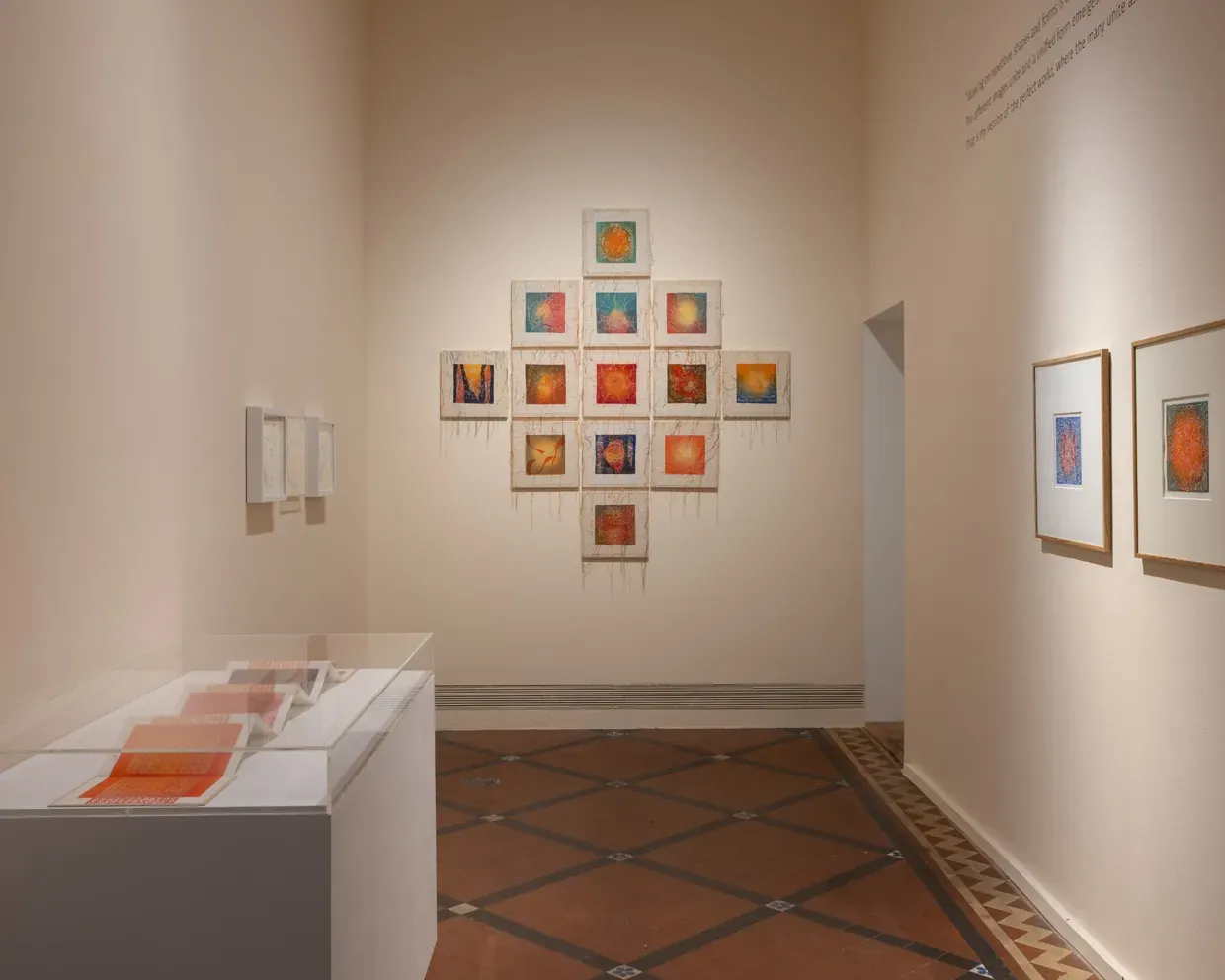
Chronicling more than four decades of her creative practice, the exhibition brings together an expansive body of Hunjan’s work, from early experiments in printmaking at the Slade School of Fine Art to more recent works in fabric. Step into the gallery and there is an immediate sense of warmth, from the richness of Hunjan’s palette to the presence of human figures and references to family and shared experience. Silkscreen-printed glass, laser-cut acrylic, metal and stonework sit alongside fabric pieces and paintings, revealing a practice that moves fluidly between two and three dimensions.
For Hunjan, the choice of material is connected to the story an artist wants to tell. “We can use different materials for different reasons. It’s only by working with a certain material, experiencing and feeling it, that one can then tell a story through it. Paint comes to mind, or printmaking, as one can manipulate it in abstract or figurative form, whereas three-dimensional work is more sculptural. Most of my work lies in between, where the paintings and prints are sometimes built ‘in relief’.”
The title was a no-brainer, says Sophie Hill, director of arts and events at Bow Arts. “Speaking through materials seemed to do justice to Bhajan’s mastery of materials – she has been innovative in her approach to materials throughout her practice. From the early etchings, some of which are scorched or indented like marks in the earth, to her pushing contractors to try new things in public art projects, like coloured concrete or sandblasting designs into granite.”
“‘Speaking’ was also key, as Bhajan’s work succeeds in speaking to many very deeply and not through obvious language,” Hill continues. “Symbols are often used in her work – organic forms, a little ladder, textual symbols that take inspiration from various different alphabets – and it’s through these symbols (cast in her various materials) that her work is so poignantly accessible.”
Private moments brought to the surface
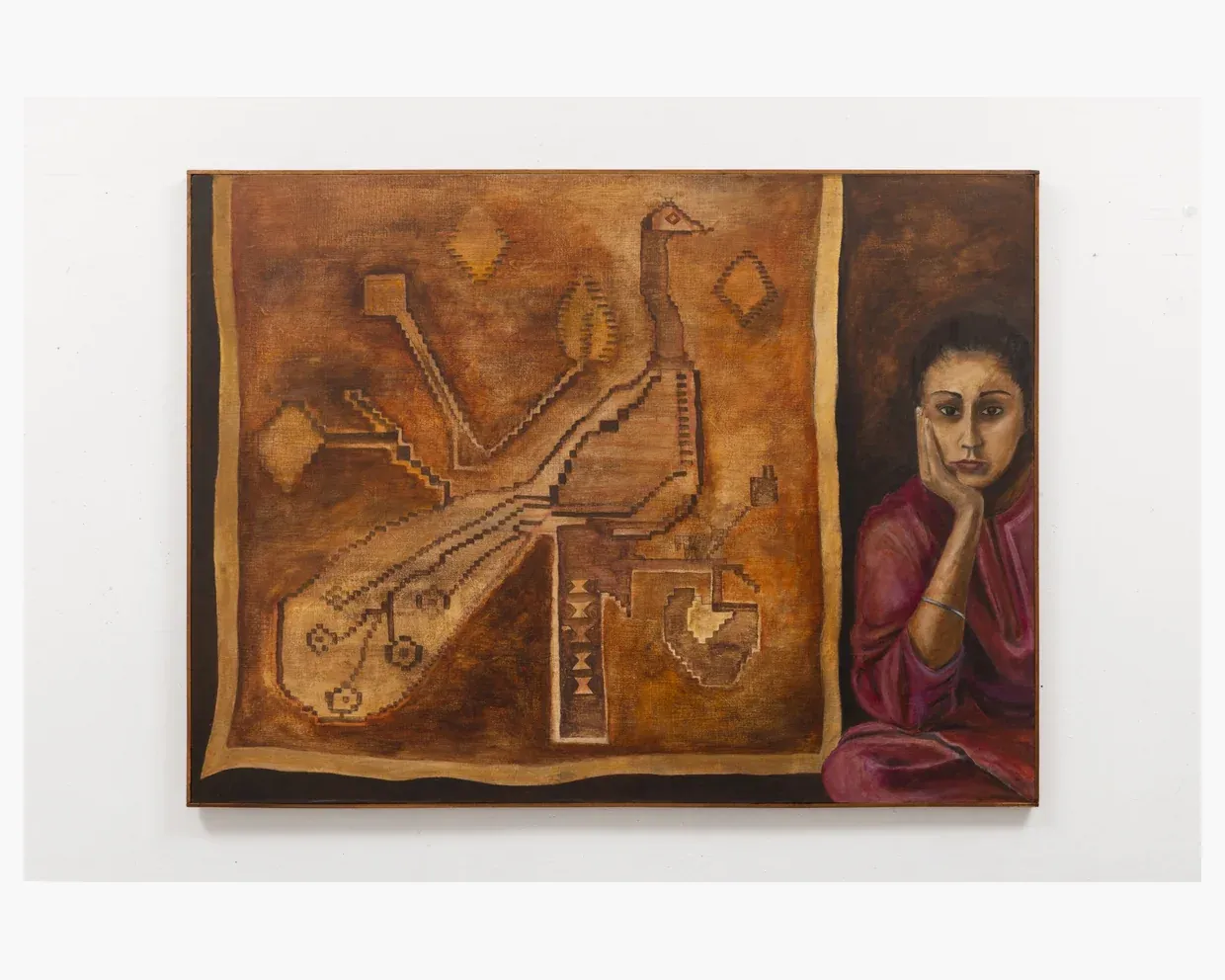
The exhibition features a number of never-before-seen works, an experience that Hunjan describes as “private moments being brought to surface”. Among them is the evocative painting My Grandfather’s Passport (1990), which explores her family’s migratory journey, and the contemplative drawing MamaJi (1980). Both pieces are connected by the presence of the artist’s mother.
“I started working on my mother’s portraits in response to her telling me once that she didn’t understand my work and what it was about. So, alongside other figurative work done in late 80s and early 90s, I thought of doing her portrait, which she could relate to. I think she was quite chuffed in a quiet way.”
The story behind My Grandfather’s Passport goes back further, to Hunjan’s first visit to Panjab, India, in 1989, when her uncle gave her her grandfather’s passport, which had been kept in a metal family trunk. “He could see how fascinated I was when he showed me this passport. I couldn’t believe it when he offered it to me, to keep it,” she recalls. The painting was originally intended for Crossing Black Waters, an exhibition organised by Panchayat in 1992, but Hunjan felt it wasn’t ready at the time. Thirty years later she returned to it, prompted by a discussion about her work from the 1980s and 90s for the SADAA (South Asian Diaspora Arts Archive) Re-United Roundtable project.
“It is an artwork about his journey from one British colony to another, across the ocean, from a British Indian Empire to British Kenya,” she explains. “The painting also includes a monoprinted tissue paper collage of my mother, who also would make a similar journey ten years later.”
Conversations with ourselves
Asked which piece in the exhibition she feels particularly close to, Hunjan points to Dialogue II (1993), a double self-portrait exploring the conversations we have with ourselves. “These dialogues can empower us or bring us down… listening to the inner voice.”
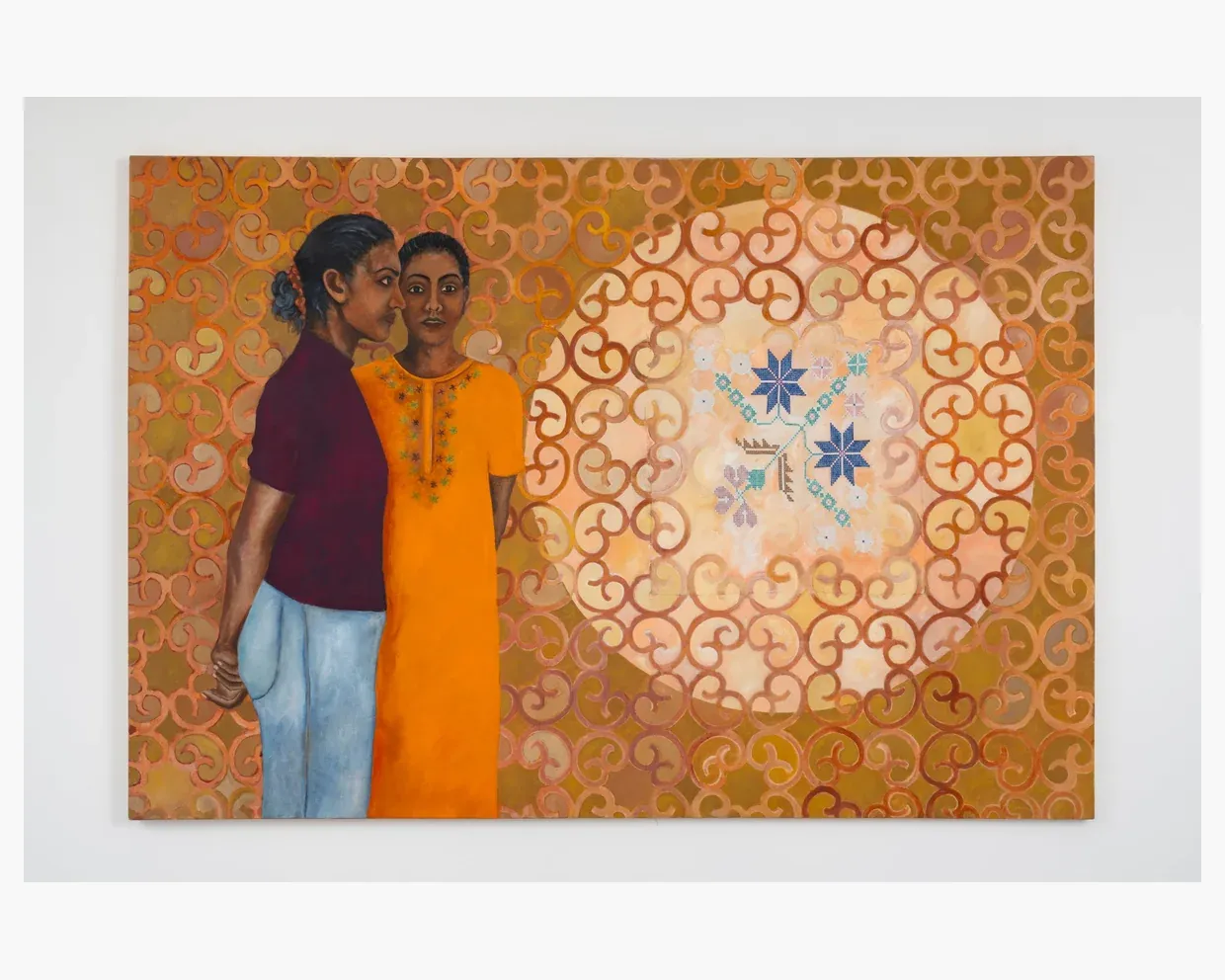
“This painting is as relevant today as when it was created,” Hunjan says. “The women could be in an interior, reflected in a mirror or outside the space, which has a lattice decorative grid surrounding the window-like shape. There are limitations or barriers within us as well as in our exterior worlds. Internally, this can be due to our conditioning, behavioural traits or internal values and habits. Externally, it’s the societal and cultural boundaries.”
Still more work to be done
The painting’s exploration of the barriers women encounter reflects Hunjan’s longstanding commitment to creating work that speaks powerfully for women and diaspora communities. A participant in the Black British Art Movement, Hunjan exhibited and curated alongside contemporaries including Chila Burman and Symrath Patti during the 1980s, at a time when Black and South Asian women artists were seeking greater visibility in Britain. Reflecting on the changing landscape of representation in the art world, Hunjan says:
“Thirty years on, more women artists have had opportunities for visibility – but it’s taken a long time and there is still more work to be done. It’s been wonderful to see work of South Asian and Black women in major institutions, having notable national and international exposure and their work and practice taken seriously. I hope this will open doors for other women artists who haven’t had the same opportunities for their works to be seen in national museums and art galleries, and to have their work acquired for national art collections.”
The exhibition is accompanied by a new artist publication from Bow Arts, supported by the Paul Mellon Centre, which celebrates Hunjan’s extensive work and features essays by Professor Parminder Bhachu and curator and historian Dr Alice Correia, a foreword by Tate curator Linsey Young and an afterword by gallerist Niru Ratnam.
Bhajan Hunjan: Speaking through materials is on show until 20 December at Nunnery Gallery, Bow Arts, 181 Bow Road, London E3 2SJ.
Find out more on these topics


