

Hackney photographer Neil Martinson is exhibiting his largest ever display of archive photographs and current work across Hackney this autumn as part of Photomonth. Hackney: An Incomplete History brings together photos from the 1970s and 80s with newer photos taken since 2019.
“I was looking at my archive pictures and I thought it would be interesting to explore what’s changed, what remains in Hackney and connect the present with the past,” he tells me. The result is spread across seven exhibitions in different parts of the borough, and one in Tower Hamlets.
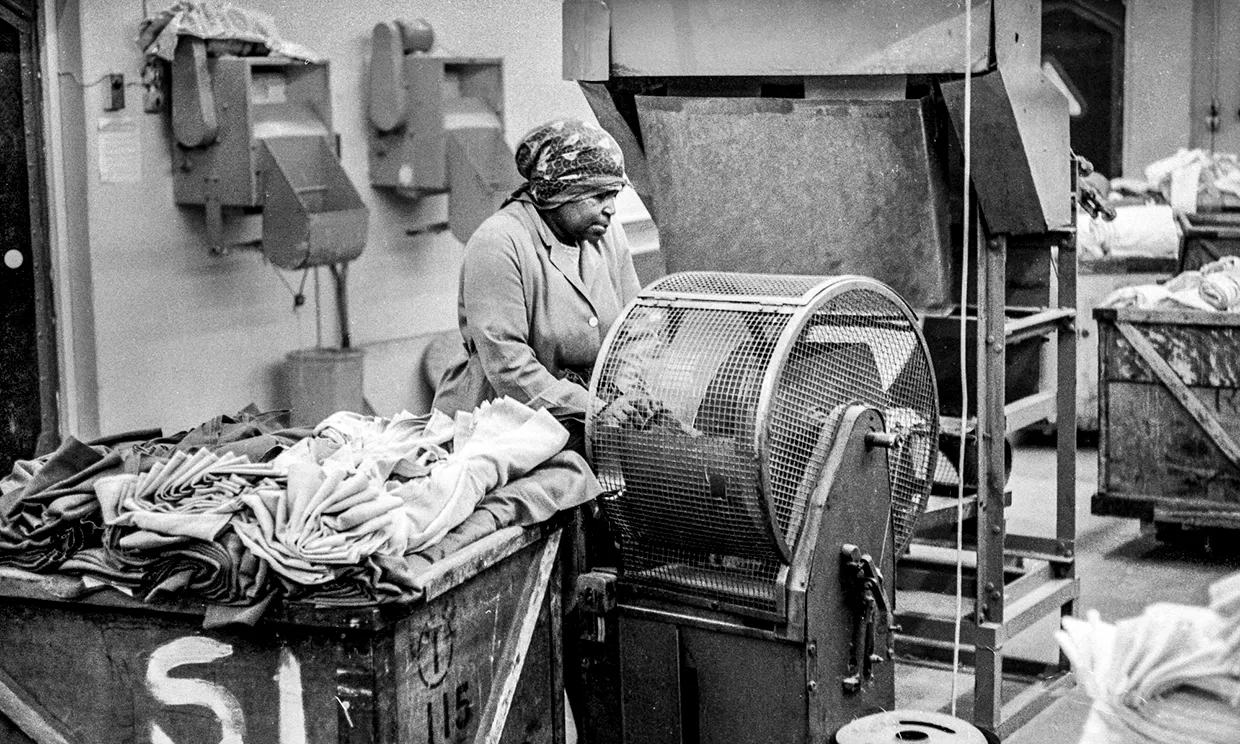
I met Martinson at Hackney Downs Studios, currently exhibiting 20th to 21st Century Work / Fifty Years Apart, exploring how work and industry have changed.
“I’ve only ever been interested in people and social political issues,” he says.
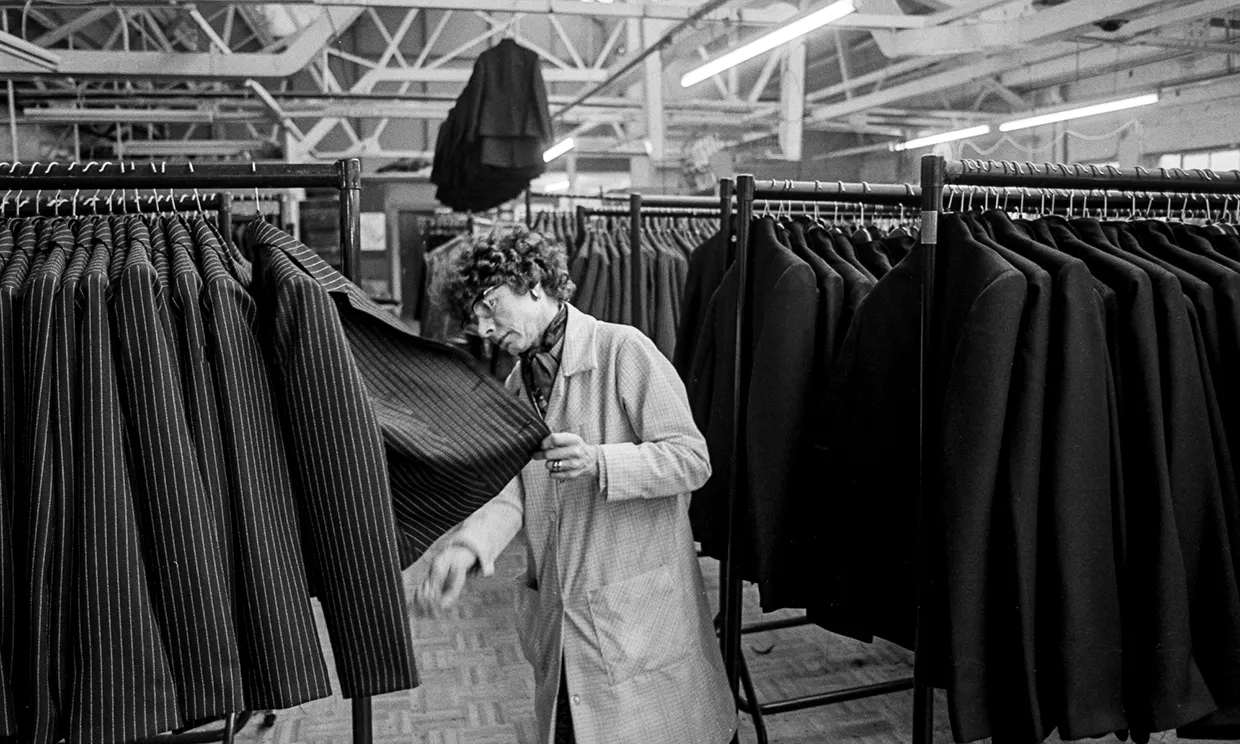
He showed me a photo he took in 1981 of Simpson Clothing Factory, which used to sit on Stoke Newington Road.
“Simpson employed at their height, 2,500 people,” he tells me. “When it opened in 1929 it was the most advanced garment factory in the world at the time. They were producing 11,000 garments a week. It was a British-owned company, and most of the people who worked there would have lived within the area. The company was paying UK taxes and the workers would be spending their money locally. Nowadays, it’s called the circular economy.”
The site has since taken on a new life.
“When I went back there, one part of it had become Beyond Retro, vintage clothing. So it’s still the garment industry, but it’s very, very different. The company that runs it is Swedish and Canadian-owned.”

Martinson also appreciates the positive social changes that emerge when looking back at his photos. With the Beyond Retro photo, he comments: “Matthew, in the 70s would have had a real problem walking down the street dressed like that.”
Elsewhere, his photos show how roles available to women have changed. A recent photo is of Reverend Laura Luz, a vicar at Holy Trinity Dalston and All Saints Haggerston.
“I took a picture of one of her [male] predecessors in 1976. I think women were only allowed to be ordained in 1994… I’ve also got a picture of a woman in a van driving a refuse truck. She wouldn’t have been allowed to do that then.”
Martinson’s eight exhibitions are popping up across different corners of Hackney.
“I wanted to ensure it appears in places that local people go to – in cafes and a community centre as well as a gallery,” he says.
At Chats Palace, The First Hackney Festival to the Last Hackney Carnival brings together photographs from the first Hackney Marsh Fun Festival in 1974 and the last Hackney Carnival in 2024, while Clowns and a Hackney Church at Tin Cafe looks back at the Grimaldi Clowns service held in Hackney churches since 1958. At Kingfisher Cafe, Ridley Road pairs archive images with recent photographs of the market.
Early days
Martinson first became interested in photography as a teenager.
“On Stoke Newington High Street, there was a camera shop called North London Cameras. And I kind of used to gaze at the cameras and think, oh they look lovely.”
At Stoke Newington Library, “there were these big photography books, which were, now thinking back, pretty awful. But they were full colour, of different places that I’d never been to. And so I saw those and thought, wow, there is stuff happening outside of Hackney. I saved up and bought a camera and just started taking pictures.”
Speaking of how the photography landscape has changed since then, he says: “In the 70s and 80s, if I was walking past a factory, I would just knock on the door and say, ‘Oh hello, can I come in?’ And they’d say, ‘Oh yeah, that’s fine.’ I can’t do that now.”
Over at Riverside Cafe, Working the River looks at the River Lea’s history as a busy working waterway and how it is used today, while Purim in Hackney at Springfield Park Cafe captures the colour and energy of the annual celebrations in Stamford Hill. Protest and Resistance at Cafe Z explores Hackney’s long history of protest, from nurses and teachers to campaigns around rat runs and low-traffic neighbourhoods. The final exhibition, Out of the Shadows at Mile End Art Pavilion, follows Hackney-born drag artist Lavinia Co-op as part of a wider look at changing LGBTQ+ life in the borough.
“This is work in progress for a planned book and these exhibitions show only a very small part of the collection. If you look back to the 70s and 80s it’s possible to see how we got to this position. I think it may be the most comprehensive documentary work about a single place in Britain photographically, across 50 years of really significant change.
“I suppose what I’d like is for, particularly people who’ve moved into Hackney in the last few years, to realise, actually, there’s a history here that has made it what it is. It’s been made by the people who live here and shaped by political and economic forces. And it’s about trying to understand what that is. If it means people look at it and start asking questions and become curious, that’s enough.”
Opening times
The first Hackney Festival to the last Hackney Carnival
Chats Palace, 42–44 Brooksby’s Walk, London E9 6DF
9 September – 1 November
Wednesday, Thursday, Friday and Sunday, 11am–3pm
Clowns and a Hackney Church
Tin Cafe, 1 Middleton Road, E8 4BL
28 September – 8 November
Monday–Friday 7am–6pm; Saturday 9am–6pm; Sunday 10am–4pm
Ridley Road
Kingfisher Cafe, 69 Kingsland High St, E8 2JS
October
Every day except Sunday, 6.30am–4pm
20th to 21st Century Work — Fifty Years Apart
Hackney Downs Studios, Amhurst Terrace, London E8 2BT
28 September – 8 November
Every day, 10am–6pm
Working the River
Riverside Cafe, The Lodge, Spring Hill, E5 9BL
Monday 5 October – Monday 2 November
Every day, 9am–4.30pm
Purim in Hackney
Springfield Park Cafe, Clapton, E5 9EF
Thursday 19 November – Wednesday 20 January
Every day, 10am–4pm
Protest and Resistance
Cafe Z, 58 Stoke Newington High St, N16 7PB
Permanent exhibition
Every day, 7am–6.30pm
Out of the Shadows
Mile End Art Pavilion, Clinton Rd, Bow, E3 4QY
Wednesday 14 October – Sunday 25 October
Every day, 11am–6pm
Check out Martinson’s website here.


