

“After Robin’s funeral, I invited everybody to come back to the flat to collect whatever paintings they wanted,” says Ruth Taylor, widow of Hackney artist Robin Cornell, who died in 2024 aged 85.
Cornell spent decades producing abstract works, but never had a gallery and didn’t want to sell them. Now, a selection of his paintings is being exhibited at The Place in Canonbury.
“I was complaining about how many paintings I still had left over. What was I going to do with those? A friend who was the owner of Vecchio Parioli asked if we could put up some of Robin’s paintings in the restaurant. So we did and then Stuart came along.”
“Yes, I bought a number,” says curator Stuart Evans. “And the reason I did is I’m entirely convinced by Robin’s practice. I think what he was doing was singular and the fact that he gave himself to it, in a way that was totally concentrated, speaks volumes. And he did it without any thought of making money out of it – he did it because he believed in it. And I bought it because I believe in it.”
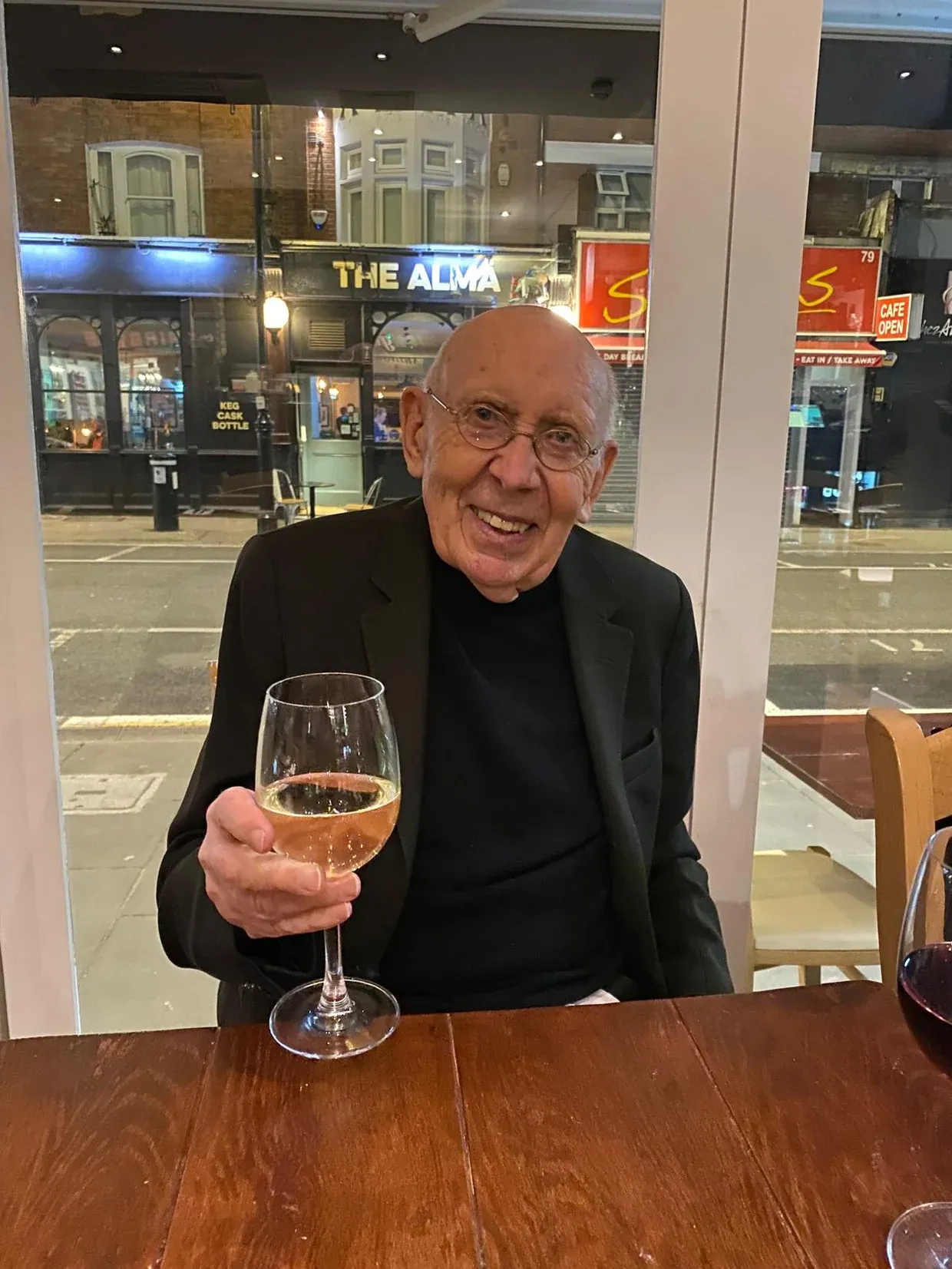
Born at Hackney Hospital in 1939, Cornell grew up in Dalston. At 15 he began an apprenticeship as a hand-compositor at Straker Brothers, a printing firm in Islington, which had an influence on his developing artistic style.
“When he was going to the print works, he could see in the distance the Barbican being built, with the masses of huge cranes and metal steel structures,” Ruth tells me. “And they informed and encouraged the geometric shapes and lines of his paintings.”
Cornell’s first abstract painting was exhibited at Hackney Town Hall in 1958, when he was just 19, and it was the only abstract painting in the show.
“He did gain a lot from his mixing with older men at the print works. He was exposed to politics and other ideas,” Ruth adds.
Union man
Cornell became a union representative while working at the Daily Worker and later rose to become national secretary of the Electrical, Electronic, Telecommunications and Plumbing Union. He also became a Labour councillor for Homerton ward in 1998. This industrial and political background fed into his interest in Constructivism, an abstract art movement that emerged in Russia after the revolutions of 1905 and 1917. Cornell joined the New Constructivists in 2002, exhibiting with them twice a year.
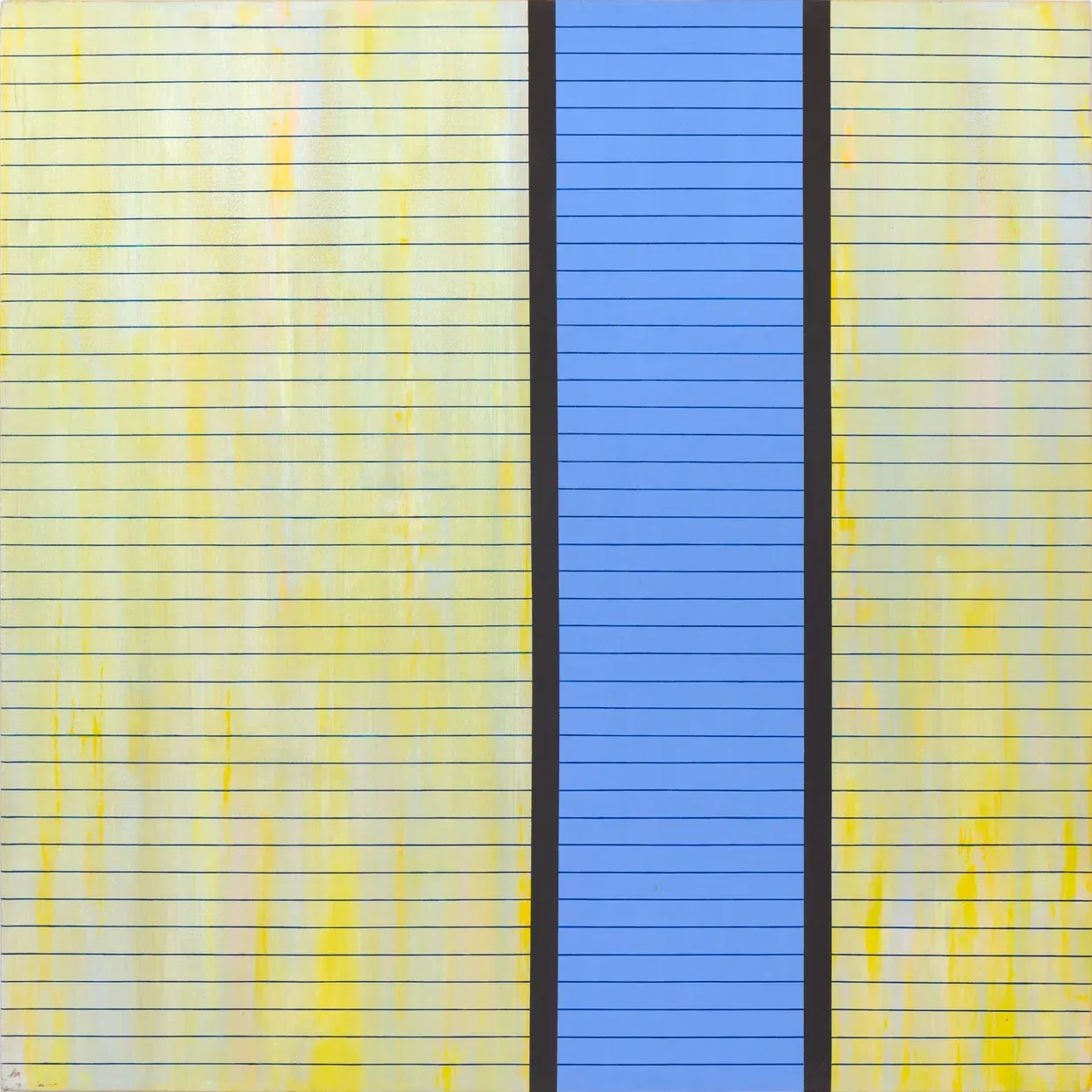
“Constructivism was supposed to be non-objective, so it wasn’t taken from your own personal emotions and experiences of life. It was to serve the development of the new society, which is quite a thing for an art movement,” shares Stuart. “And I think that appealed to him, the idea of that radical change from a reactionary feudalistic society to a socialist society. Because that was his own politics.”
In the 90s, Cornell took an art foundation course at Central Saint Martins, followed by a year of public art at Chelsea School of Art and a Fine Art degree at Wimbledon School of Art. When he and Ruth moved into a converted factory loft with enough space for a studio, he eventually resigned from his trade union work and concentrated more on his art. “He was never happier than being in the studio painting his abstracts and playing Bob Dylan or jazz very loudly,” reminisces Ruth.
I ask Ruth why he never wanted to sell his paintings. “He disclosed in one of his [university] essays that persistent use of lines in his paintings could possibly be related to deep psychological reasons that he had no access to. I’m glad he said there was no access to them because that leaves us all to guess,” she says with a laugh.
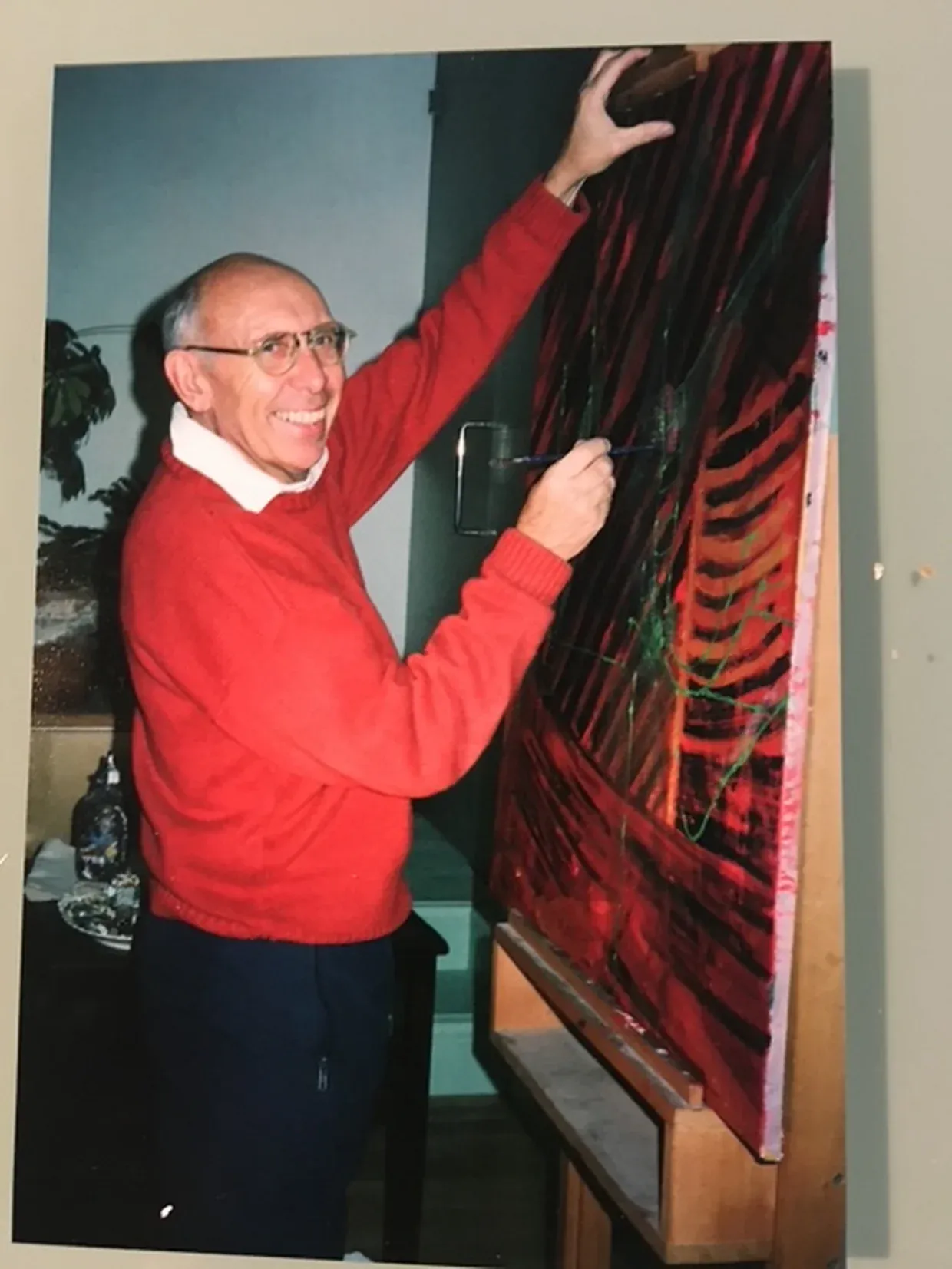
“My view is that they were all his babies and he wasn’t going to let them go. Because when he was a child, he had a severe separation trauma after the war. It really left a mark for the whole of his life…. Art certainly was a way of self-expression that nobody could take away from him.”
Final work
As the pair talk me through some of the artwork on the walls, we come to a striking trio called Malevich’s Memory. Ruth explains that Russian artist Kazimir Malevich, and his famous abstract piece Black Square, were an inspiration to Cornell. When Black Square was unveiled in 1915 at an exhibition in St Petersburg, Malevich put it in the top corner of the room by the door.
“That was very subversive because that was exactly the place in Russian homes where the icon of the Orthodox Church would be,” Ruth says. “So I think Robin, when he did his little black square in Malevich’s Memory, was because he rather admired the nature of what Malevich had done and the subversion.
“That was the last painting Robin completed and he thought that was his masterpiece.”
The exhibition will run until 10 December at The Place, where Stuart has been putting on exhibitions since 2014. “I like showing art in what I call a compromised space,” he says. “There’s something very intimate about showing it here.”
But this exhibition is also part of a bigger ambition for Stuart. “My mission is to try and persuade museums that Robin Cornell deserves to be numbered among the abstract artists of this country and his work shared. So I’ve got meetings ahead of me which may lead to his work going into museums, which is very exciting.”
Robin Cornell’s artwork is being exhibited until 10 December 2026 at The Place, 11 Canonbury Place, N1 2NQ.


Comments