

A 35-storey ‘co-living’ tower near Old Street has won planning permission, despite only three of the seven councillors on Hackney’s planning committee voting for it.
The other four abstained.
Developer HUB will demolish Finsgate House on Cranwood Street and replace it with a tower of 490 single-occupancy studios and a separate five-storey office building.
The scheme includes no affordable housing on site. Council officers told the committee on Wednesday 11 November that this conflicted with the borough’s own housing policies, but that a £18.2m payment from HUB towards affordable homes elsewhere in Hackney outweighed the harm.
Committee chair Cllr George Sheldon Grün voted in favour, alongside Cllrs Mihai Chereji and Benzion Papier. Cllrs Anntoinette Bramble, Reiner Tegtmeyer, Jas Crowe and Kwame Otiende abstained.
Nicholas Blincoe, Green party councillor for Hoxton West, spoke against the scheme on behalf of residents and was then told to leave the chamber. He later told the Citizen: “A vote with four abstentions to three is not a positive outcome.”
Policy conflict
Hackney’s Local Plan makes conventional self-contained homes the priority, and only allows co-living where a site is unsuitable for them.
Case officer Oliver Enticott told councillors: “If we really wanted to, probably, or from the council’s position, we think that probably that you probably could get regular C3 housing on the sites.”
A senior planning officer confirmed that, as a result, the scheme “can’t comply with the housing policies”.
Officers argued that a conventional block on the site would have produced only small flats, with no family homes and no affordable housing contribution. The same officer said the £18.2m “more or less matches all the contributions we’ve received over the last 10, 15 years”.
HUB said the money would fund 105 social rent homes, but officers said the developer was “slightly overestimating”. By the council’s estimate, it would pay for 35 to 40 new homes built outright, or around 80 to 100 social rent homes if put into existing council schemes.
HUB’s first offer was £10m, which rose to £18.2m after negotiation with the council’s viability consultants. The Greater London Authority initially questioned whether £18.2m was the most the scheme could afford, but an addendum published before the meeting said GLA officers are now satisfied the sum is acceptable.
Rents
Council reports put the average rent at £600 a week per studio. HUB managing director Damien Sharkey told the committee those were not the company’s figures.
“The 600 pounds per week are not our rents. They’re rents that were identified by the council’s viability assessor as part of determining the payment in lieu. We – our rents were lower, but the rents were moved up to help determine that payment,” he said.
He added that rents would include bills, council tax and use of the gym, and that HUB’s research put them 12 per cent below a new-build studio nearby.
Cllr Crowe, who lives nearby on Haberdasher Street, said the business plan’s rent of £525 a week came to around £27,300 a year – “two grand less than living wage”.
“My rent is and bills total and council tax are less than half of what you’ll be charging, and I’m in a two-bedroom flat sharing with someone,” she said.
Officers said no lower-rise version of the scheme was put forward before the application was submitted.
Objections
Notification letters went to 2,653 neighbouring properties, and 26 objections were received. The Hackney Society’s planning group objected to the “relentless repetition of identical bedsit dwellings”.
At the meeting, resident David Gingell said the tower had “the architectural merits of a Kellogg’s cereal box”, and warned it would worsen “what is already approaching a strong and dangerous wind corridor, a threat to life and safety”.
HUB’s planning agent Adam Donovan, of Lichfields, accepted the area was already very windy, but said wind tunnel tests showed the tower “doesn’t actually significantly worsen that position”.
Trudy Rance, secretary of City Road Residents Association, said the tower would leave neighbouring flats “living in minimal light”, and disputed the developer’s daylight study, which treated some affected rooms as bedrooms.
“They were saying that they were bedrooms, so it didn’t matter. But they’re actually not all bedrooms. I know because I live there and I’ve been in other people’s flats, too. It is their kitchens. It is their main rooms,” she said.
Donovan said about eight per cent of the estate’s 200 or so homes would be affected, mostly on the ground floor. Officers described the loss of light as “fairly modest” and acceptable for an urban area, “with some exceptions”.
Bricks
Cllr Blincoe told the committee residents of the neighbouring estate “feel small”, and said the estate was “among the worst pieces of social housing in Hackney”.
“It needs love, care, and urgent attention. It doesn’t need to be blighted for the years this building will take to build before being plunged into darkness until the tower is pulled down as obsolete,” he said.
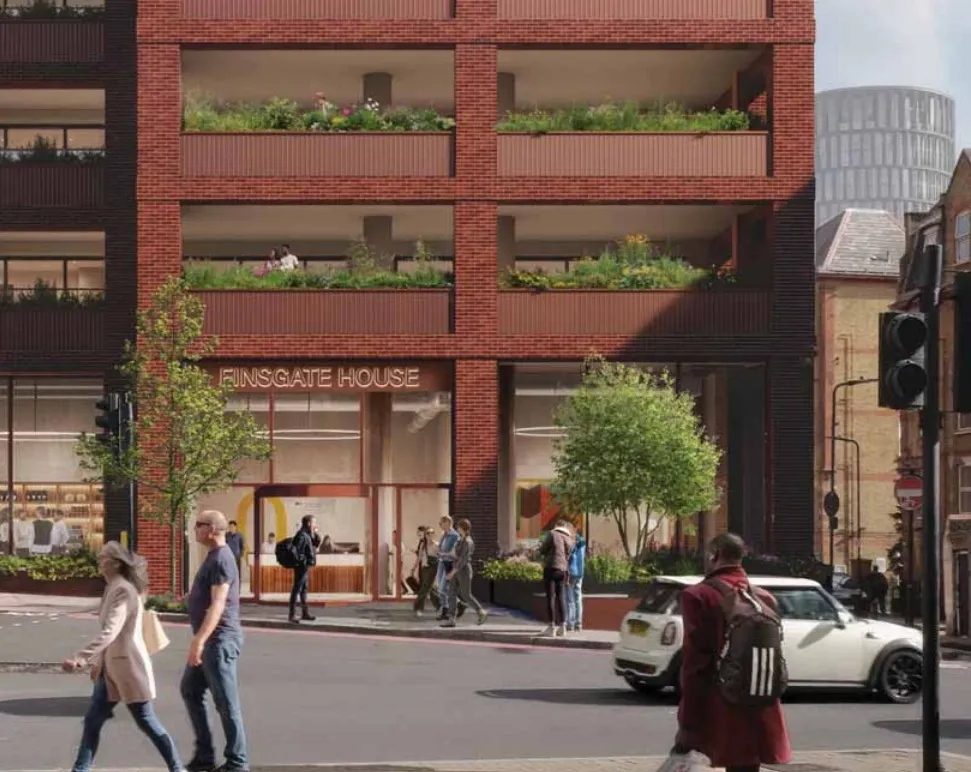
He also attacked the brick facing designed to make the tower match the estate, quoting architects of another Hackney scheme who had called bricks “just really heavy and expensive wallpaper”.
“The improvement of the building hinges on good design, it turns out the design rests – excuse me – on shit bricks,” he said.
Hackney’s principal climate change officer told the committee “there are lower carbon alternatives out there” that would suit the building. The co-living tower also falls short of the London Plan’s 35 per cent target for cutting operational carbon, which officers said was “not uncommon for like building of this scale”.
There will be no blue badge parking on site. The council’s highways officers objected, and the case officer called it “definitely one of the negatives of the scheme”.
Ordered out
Finishing his speech, Cllr Blincoe told the chamber: “Apparently, I have to leave now. I’ve been told I have to leave. I don’t want to.”
He later explained to the Citizen that he is a substitute member of the committee and had spoken as ward councillor for constituents who had objected. He also lives on Charles Square, near the site.
“I was advised by governance to leave after I had spoken, so there would be no question of my influencing my colleagues,” he said. Asked how he would have voted, he said: “I would have voted against.”

He said councillors’ hands were tied by planning policy they had not written: “The issue is that we’re legally obliged to work to a plan we had no say in.”
“We will publish a Green Hackney plan but our hands are tied until then. Our plan can’t come too soon,” he said.
HUB bought Finsgate House for £31m in July 2024 in partnership with US private equity firm H.I.G. Capital.
In his speech, Cllr Blincoe said: “It’s a highly speculative project. If the idea of bedsits-in-the-sky turns out to be a dud, we’ll see the owners retrofitting the building with conventional apartments before they finish building it,” he said.
“If the costs go up, we may not even see the promised £18 million . We all know examples of contributions renegotiated because a project has become more expensive.”
Support
HUB’s head of development, Victoria Manson, said the scheme offered “a safe, well-managed alternative to the poor-quality private rented housing many Hackney residents rely on today”.
The Shoreditch Trust, which will run a free community space on the ground floor, urged councillors to approve the plans.
The council has agreed a construction cost allowance of £108m. A late-stage viability review in the legal agreement means any rise in profit or savings as the development nears completion would trigger an extra payment to the council.
The decision now goes to the Mayor of London for a final stage two referral.
With additional reporting by Hackney Citizen.
Find out more on these topics


