

Two trees inside the All Points East festival site in Victoria Park were cut back to bare trunks during this year’s event, despite promoter AEG telling planners that no trees would be removed or pruned.
Both had been flagged as being in severe decline in a survey AEG itself commissioned in May, but neither appears in the measures the company has put forward to protect trees in the park.
Meanwhile, Tower Hamlets Council has missed its target date to decide whether AEG can use a third of the park for up to 75 days a year for the next six years.
Victoria Park is owned and run by Tower Hamlets but sits on the borough’s border with Hackney, and is the nearest large green space for residents of South Hackney, Hackney Wick and Victoria Park ward.
All Points East has been held in the park every summer since 2018, apart from 2020, when it was cancelled because of Covid. Residents say this year’s edition, in a summer of heatwaves and drought, left visible damage from heavy footfall and machinery.
Figures released in late July under a freedom of information request show the neighbour response count was 1,554 in objection and just 12 in support, including emailed representations.
The application
Since May 2025’s Brockwell Park ruling, festivals such as this one, which use land for more than 28 days a year including set-up and de-rig, require planning permission.
Before this, AEG held All Points East without planning permission, relying on permitted development rights on the basis that only event days counted towards the 28-day limit.
The application from AEG, submitted in March this year and validated in June, would allow the use of a third of the park for up to 75 days a year for six years.
This includes eight ticketed commercial days of up to 50,000 people, four of up to 40,000 people, and eight free-to-access community days of up to 20,000.
The decision was expected on 1 September, but this was missed. One of the suggested dates for decision, 10 September, has also passed, with it not known when it can be expected.
The planning statement includes letters of support from TfL, the Met Police, and the park’s management team.
Green space
Tower Hamlets and Hackney are respectively the first and third most densely populated boroughs in England and Wales, and Victoria Park is one of the largest green spaces serving both.
Residents are alarmed at the prospect of losing the most open part of the park for up to 75 days a year, in summers many fear will only get hotter and drier.
Noemi Klein, 49, leader of the Protect Victoria Park campaign against AEG’s use of the park, said: “This is where children go to play, this is where people play impromptu football.
“The festivals turn the park into a complete dust bowl, this has been well documented, it’s been on the news.”
Lost trees
AEG’s arboricultural method statement made clear that “no tree removals or pruning works are proposed as part of the event infrastructure.”
Many who have visited Victoria Park since the festival walls came down, however, may have noticed the two trees, near the Hub Cafe, now standing as monoliths.
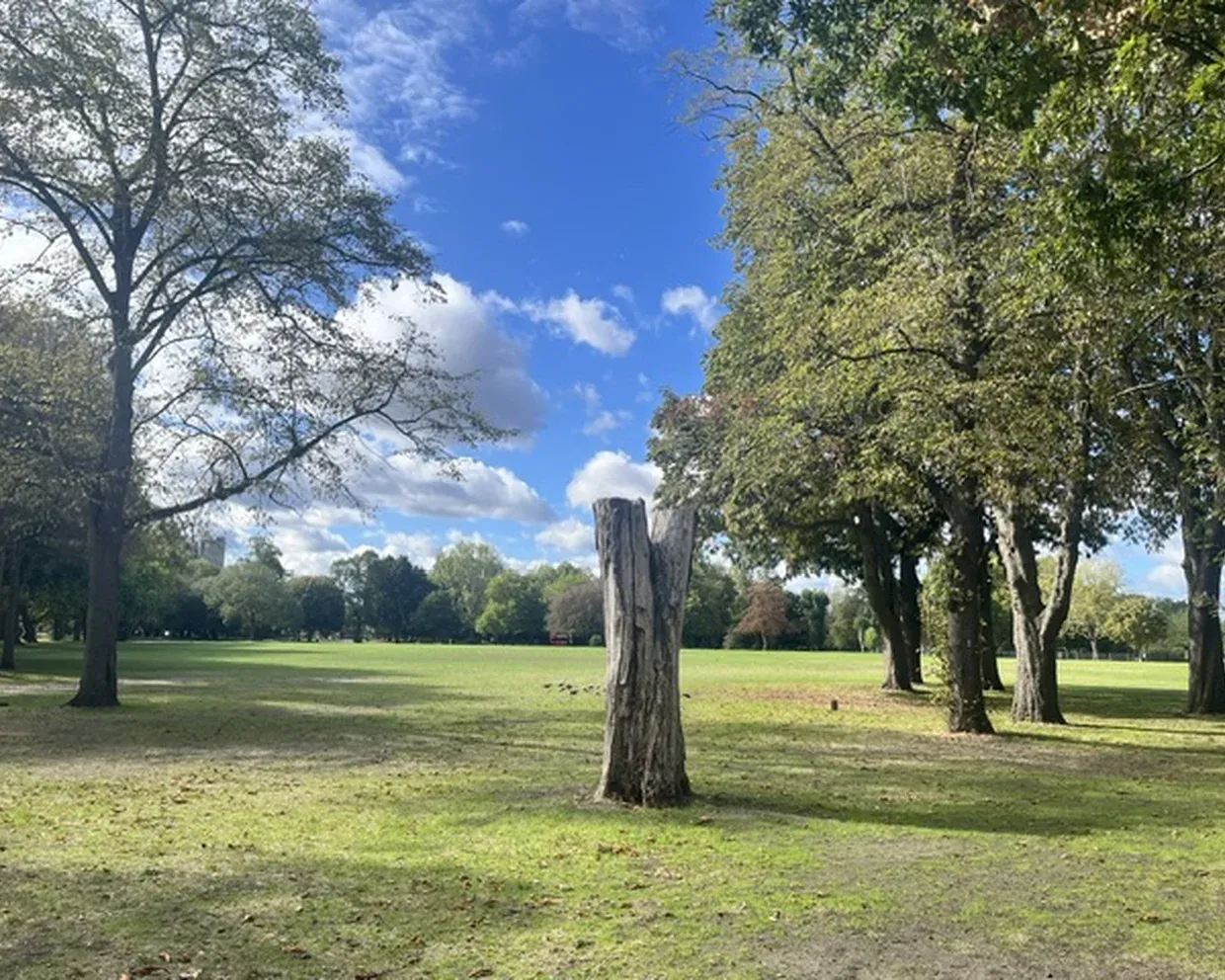
The council has confirmed that the trees were reduced to monoliths on 25 August, during the festival period, and that concern about them was raised by AEG itself.
By comparing photographs and the trees’ locations with the survey commissioned by AEG in May, the Citizen identified them as tree 85T, a black poplar, and tree 91T, a silver maple.
That survey placed both in category U, defined as trees that cannot realistically be maintained as living trees for more than 10 years.
They had been historically topped, and had around 5 per cent of their expected foliage. Neither was dealt with before the festival build began.
An AEG statement specified that the assessments were carried out by third-party arboriculturists hired by the promoter itself, and Tower Hamlets Council confirmed that the work on the trees was also carried out by AEG.
An AEG spokesperson said of the silver maple: “The observed combination of decline/poor structural qualities and prolific fruiting of Cerioporus squamosus was considered sufficient to recommend removal rather than reliance on further short-term pruning.”
Cerioporus squamosus is more commonly known as dryad’s saddle.
And of the black poplar: “The adjacent tree displayed overt dieback and a structurally compromised trunk/base. Removal was recommended.
“In agreement with Council arboricultural officers, the trees were reduced to monolith height rather than completely removed, preserving their valuable ecological and habitat contribution to the park.”
Thirteen trees
The two trees were among 13 category U trees noted in the festival area. Five were already dead when the May survey was carried out.
Speaking to the Citizen, Gareth James, 63, chair of Clapham Common conservation charity Wild Clapham, and contributor to the Brockwell Park campaign, said: “It is astonishing in such a small area to have 13 trees that are category U that are expected to die within the next 10 years.”
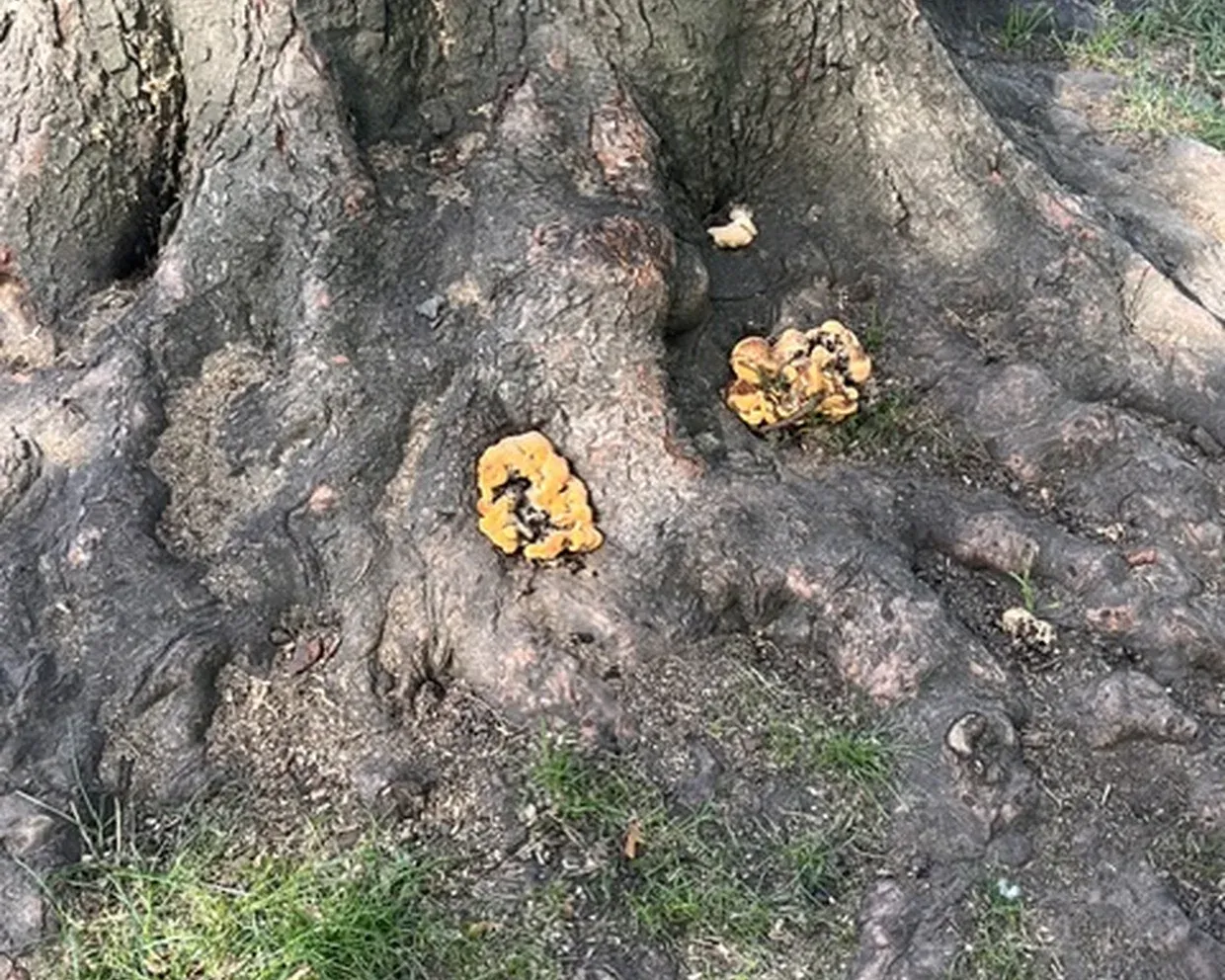
The silver maple also had a visible orange fungus growing from its trunk, which James identified from photographs as chicken of the woods, a visually distinct species from Cerioporus squamosus, not mentioned in AEG’s report.
James also said that heavy footfall and the use of heavy machinery around the root area, particularly in dry weather, can stress trees and leave them more vulnerable to fungal decay.
He said: “[It] squeezes out all the air from around root systems. They need oxygen to stay alive. You’ll kill off all the microbes, all the springtails, all the earthworms, it’s devastating.”
He said the generally poor condition of the trees in the area could also be down to previous years’ festivals and the footfall they generated, as these symptoms do not become visible immediately.
In a representation to the council, Bob Warnock, executive director of the Ancient Tree Forum and former superintendent of Hampstead Heath, said: “[the council is] being asked to grant a six-year planning permission before the final protection arrangements for all affected trees and RPAs are known.”
A spokesperson for Tower Hamlets Council said: “Two trees were removed from Victoria Park due to structural decline, which posed a risk to public safety.
“The council undertakes regular inspection of trees by in-house Arboriculturists, in line with the Tower Hamlets Tree Management Plan.”
This is despite AEG claiming that the trees were reduced to monoliths rather than removed.
Tree plans
AEG’s arboricultural method statement includes a number of measures, such as fencing types, ground protection and monitoring, but does not attribute any of them to specific trees.
AEG’s reason was the “evolving layout” of the festival, but internal emails show that when senior arboricultural officer Adam Armstrong inspected the set-up, it was noted to be the same as in previous years. This discrepancy does not appear to have been resolved.
AEG’s tree risk-benefit management strategy, produced by the same consultancy a week after the survey, assessed only two groups of London planes, rated a “Not Tolerable” risk because of Massaria disease. The document says such risks “will be reduced to an Acceptable level”, but the only measure listed was to notify the council’s arboricultural officer.
The strategy assessed only two zones of the park. Neither the poplar nor the maple appears in it, even though the survey recorded both with around 5 per cent of their expected foliage – and the strategy itself lists low leaf cover and dead trees as obvious risk features.
The main festival area and the area near the Hub Cafe were not included in the strategy as they were not treated as “high-confluence” zones, even though the festival site has capacity for up to 50,000 people.
James said: “Why is AEG responsible for assessing tree health? That should be done independently. It is a conflict of interest, why are they not joining the dots? Why do you have so many trees that are in decline?”
Wildlife
Most planning applications in England must show a biodiversity net gain of at least 10 per cent.
AEG’s biodiversity net gain statement says: “It cannot be certain that habitats which may be affected by the events will be restored before the event reoccurs the following year. Thus, habitats may be temporarily lost/impacted over two years.”
Warnock said that repeated annual use of the park “has the potential to result in gradual degradation of rooting conditions through compaction, disturbance and operational activity over time.”
Klein said: “If there isn’t a year where this doesn’t happen, the ground turns more and more into concrete, it can’t recover.”
Victoria Park is also home to common pipistrelle bats, which AEG’s ecological impact assessment admits face “likely significant effects” on their foraging, roosting and commuting, even with mitigation.
Klein said: “One of our neighbours has a bat box outside her house and used to always have around 70 bats who frequent there, but in the last couple of years it is down to 20.”
James also raised concerns about the effect of the festival’s music on birds, with set-up starting in nesting season and the festival itself coming towards its end.
“Large prolonged bass wavelengths and sound will really disturb nesting birds and you can cause the parents to abandon their nests, it also means that birds can’t communicate with each other, they can’t alert each other to predators.”
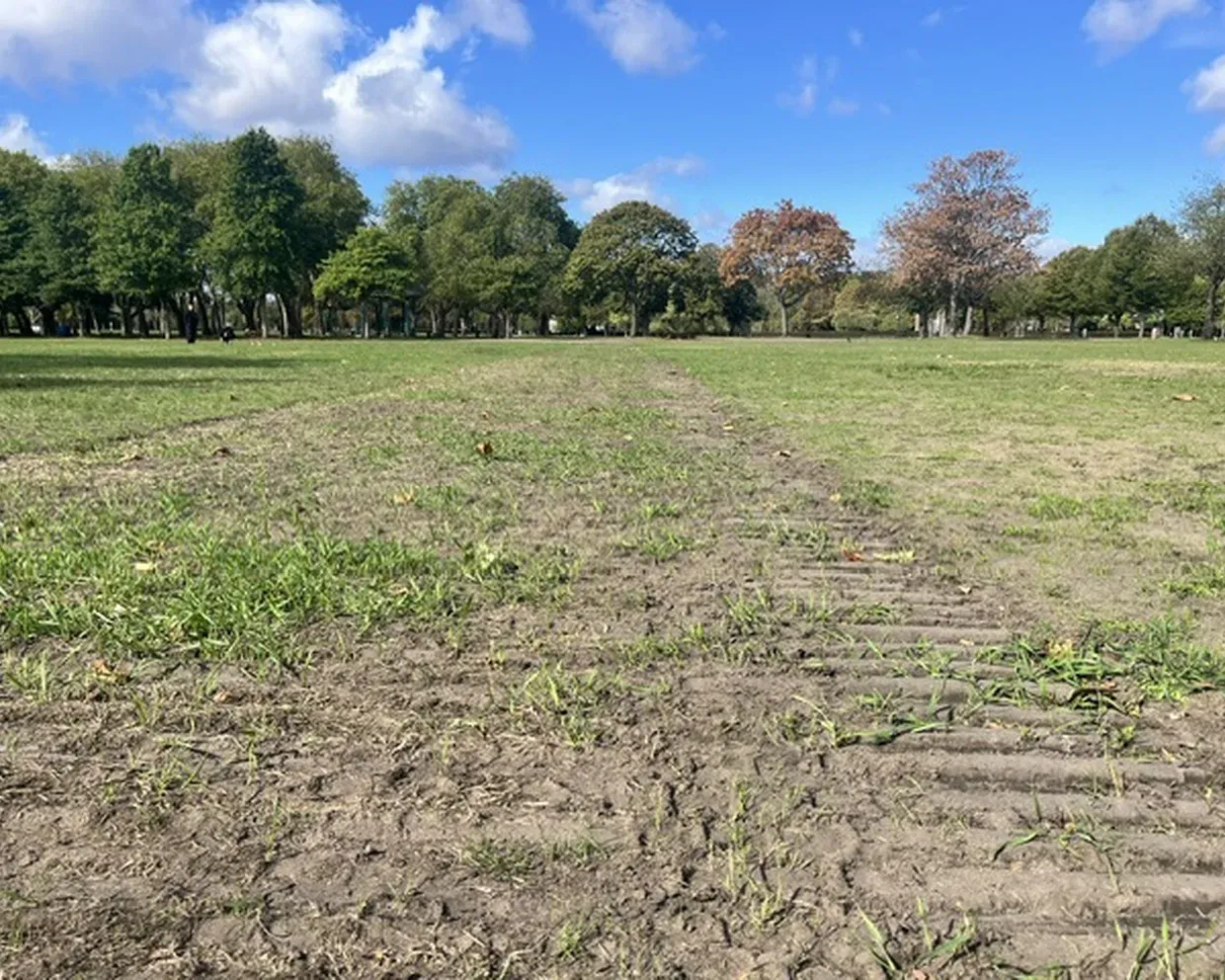
AEG’s biodiversity net gain plan, intended to make up for impacts the company itself has identified, only includes measures to boost wildlife in other parts of the park. The festival area is left in its degraded state, with grass there visibly struggling to grow compared with elsewhere in the park since the end of this summer’s drought.
Dust
Residents have also raised concerns about dust and air quality, given this summer’s run of heatwaves and drought.
AEG’s own air quality neutral statement concedes that emissions from the generators used for the festival exceed the relevant benchmark.
Sefkan Altuntop, principal air quality officer at Tower Hamlets Council, wrote in an internal email that AEG’s claim this had been sufficiently offset “has not been demonstrated through a revised residual emissions calculation.” It is unclear whether this was resolved.
The Canal and River Trust, a statutory consultee, said in its response to the application that the dust management plan did not consider the impact on canal and river users, and lacked detail on where runoff water would go if surfaces were watered. It also raised concerns about noise.
Emails also show that as late as July, AEG had not provided a clear waste management plan, alarming park users given the quantity of waste generated by so many large-scale event days.
These factors, alongside the wildlife impact, have fuelled objections to the plans among residents, and a general feeling that AEG’s proposal is insufficiently detailed in its protection of the park and its users.
Klein said: “They take no responsibility for the destruction that they cause, they have put very very few mitigating strategies into their proposal, I think they have been deliberately downplaying these risks.”
AEG was approached for comment.
Asked whether she hoped Tower Hamlets Council would take this into account when assessing the application, Klein said she doubted it, given the council’s tight budget.
‘Dereliction’
James pointed to the human benefits of green space, citing a Scottish study that linked woodlands to lower rates of antidepressant prescribing.
He was especially critical of AEG’s tree protection plans, and of the fact that the festival is permitted on parkland at all.
“It is irresponsible and it is a dereliction of duty for local authorities to be behaving in this way, trying to make a fast buck off a festival that nobody really wants, just to top up the coffers in your general budget.
“This is no time to be messing around with trees on parkland.”
A report by Urban Plant Lab found that, if no changes are made to species selection, 73 per cent of London’s current public trees may struggle to thrive or survive by 2090.
Campaigners fear the two monoliths could be a sign of Victoria Park’s future if the planning permission is granted, although it is still not known when a decision will be made.
A Tower Hamlets Council spokesperson said: “The planning authority has received a planning application from AEG Presents, which looks to formalise the number of days where Victoria Park will be used for major events, including days for set up and take down.
“The application is currently being assessed and will be reported to the strategic development committee for a decision at a future meeting of the committee.”
Find out more on these topics


