

Dalston is set to see new traffic filters to stop drivers shortcutting through residential roads, in a bid to cut “dangerous” levels of through traffic.
Hackney Council has put forward proposals for further road restrictions, a bus gate, a new pedestrian crossing and other measures in Dalston. The council says the scheme will be financed by nearly £3 million in TfL funding, though the officers’ report approving it in February said only £148,000 had been confirmed, with just over £2 million more requested. The traffic filters are intended to stop vehicles using residential roads as shortcuts, otherwise known as “rat running”.
The scheme, which is still subject to statutory consultation, is designed to improve a neighbourhood the council says “suffers from heavy through traffic and unsafe road conditions”. The measures are also intended to boost air quality and make it safer to walk and cycle in the area.
The cabinet member for climate, clean air, energy and transport Cllr Jacob Cable said residential streets in Dalston had “long been affected by dangerous levels of through traffic”.

“We’re now moving forward with this long-awaited and much-needed scheme, which will make the area a safer, healthier and more welcoming place. This means improving conditions for walking, wheeling, cycling and public transport, enhanced public spaces, as well as preparing Hackney for a changing climate,” he said.
Consultation
The announcement follows a public consultation round held in summer 2025, which drew 1,136 responses. Roughly 9 in 10 respondents said they lived in the local area, with half (51 per cent) giving postcodes within the scheme area. Nearly half (46 per cent) of total respondents said they used a car or van to get around the area. According to 2021 Census data, 30 per cent of households in the Dalston area have access to a car.
The planned changes include a 24-hour bus gate on Shacklewell Lane between Shacklewell Road and Amhurst Road. All vehicles will be banned from passing through here except buses, emergency services, council refuse trucks, cyclists and holders of specific permits, such as Blue Badge holders who have registered a vehicle.
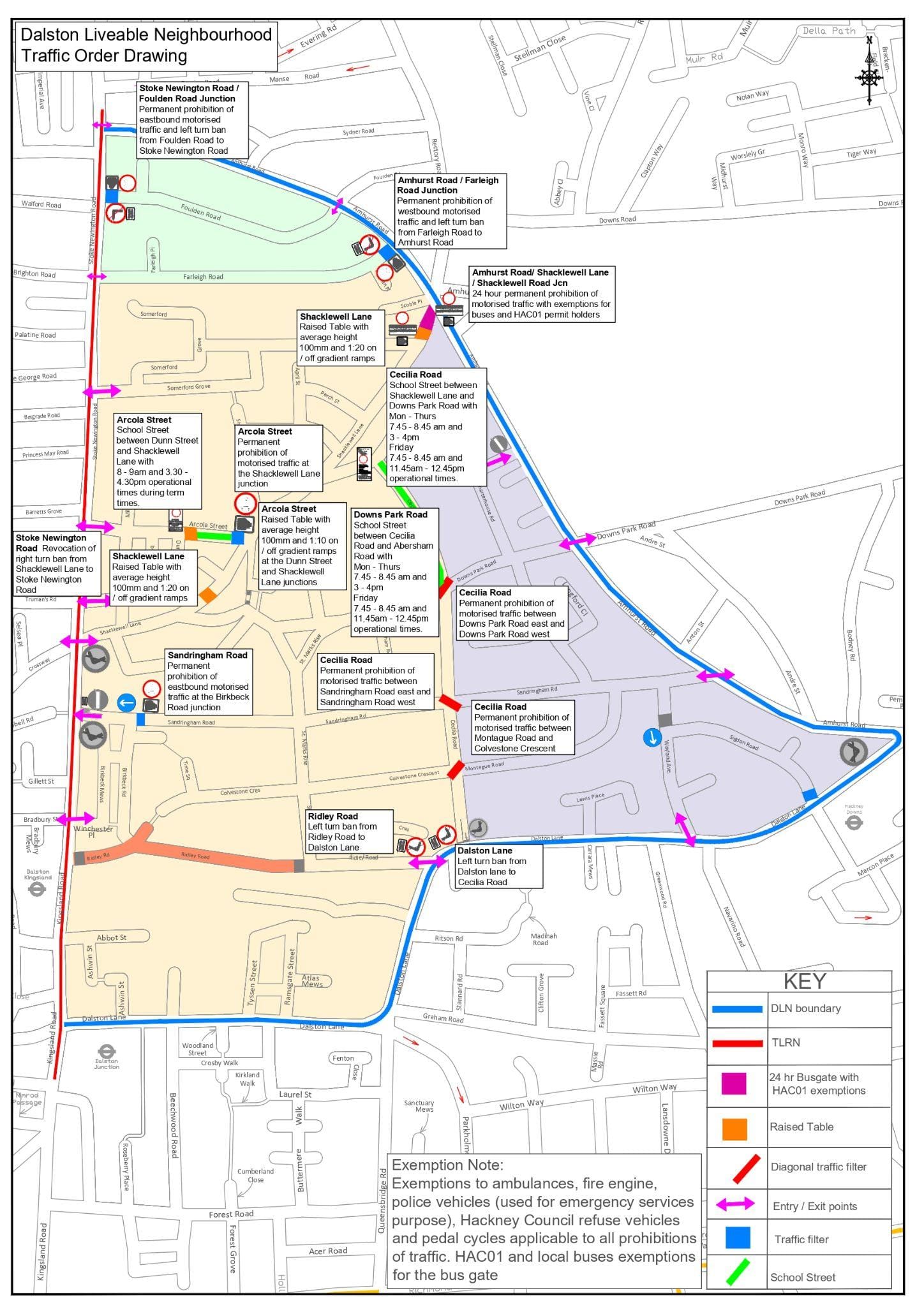
Cecilia Road, connecting Shacklewell Lane with Dalston Lane, will see new restrictions designed to stop straight-through traffic.
The proposals also include new School Streets, designed to improve children’s safety and encourage walking and cycling to school. These will cover Arcola Street outside Halley House School, and Cecilia Road and Downs Park Road adjacent to Excelsior Academy.
Locals split over scheme
Hackney has one of the highest numbers of Low Traffic Neighbourhoods (LTNs) in the capital. Since 2020 the council has rolled out the controls across the borough, which now cover 70 per cent of “all eligible roads”. Though the latest scheme is dubbed a Liveable Neighbourhood, rather than an LTN, the latter term was used by some respondents in the consultation.
The response to the plans divided residents, mostly between those living in the area who drive cars and those who do not.
For example, plans for the Shacklewell Lane bus gate were backed by nearly half (48 per cent) of respondents, driven by strong support from non-car users. Opposition among the large minority (43 per cent) who disagreed was highest among car users, caregivers, disabled people and renters.
Homeowners were heavily over-represented in the consultation. Nearly six in ten people who responded owned their home, but in Dalston as a whole only three in ten households are owner-occupied, according to the 2021 Census. They backed the bus gate by 56 per cent to 34 per cent, while renters opposed it by 52 per cent to 43 per cent. The council officers’ report said the imbalance “may have influenced the results”.
| Group | Agree | Disagree | Not sure |
|---|---|---|---|
| All respondents | 48% | 43% | 9% |
| Homeowners | 56% | 34% | 11% |
| Renters | 43% | 52% | 6% |
| Live in scheme area | 50% | 40% | 10% |
| Live outside scheme area | 47% | 47% | 6% |
| Car users in scheme area | 27% | 66% | 7% |
| Non-car users in scheme area | 70% | 17% | 13% |
| Disabled people | 26% | 68% | 6% |
| Carers | 29% | 65% | 6% |
| Aged under 35 | 54% | 40% | 6% |
| Aged 65 and over | 39% | 49% | 12% |
Source: Dalston Liveable Neighbourhood consultation report, Field Sauce for Hackney Council, September 2025.
| Group | Respondents | 2021 Census |
|---|---|---|
| Homeowners | 59% | 30% |
| Renters | 41% | 70% |
| Aged under 35 | 21% | 58% |
| Aged 55 and over | 29% | 14% |
| White | 67% | 59% |
| Black | 10% | 18% |
Source: Dalston Liveable Neighbourhood consultation report, Field Sauce for Hackney Council, September 2025. Compares 1,136 respondents with 2021 Census figures for the Dalston area. Census age bands were estimated by the consultants. Ethnicity excludes those who preferred not to say.
Objections
Residents who objected to the scheme raised concerns about delays and traffic being “funnelled” elsewhere. One said existing schemes had already caused more pollution as idling cars were forced to wait longer at traffic lights. A small takeaway owner who responded said existing traffic controls in the borough had already hindered the business’s food deliveries in Hackney due to curtailed routes.
Dalston Lane, on the scheme’s southern edge, has some of the highest nitrogen dioxide readings in the borough, and TfL modelling for the scheme predicts more westbound traffic on it.
However, supporters of the scheme included cyclists who deemed Shacklewell Lane “extremely dangerous”. Other respondents, including a Foulden Road resident, welcomed moves to curb rat running and “road rage” on both sides of their narrow road, “sometimes ending violently in a stand off”.
The School Streets received the most support of all measures, with 57 per cent of respondents in favour.
| Proposal | Agree | Disagree | Not sure |
|---|---|---|---|
| Shacklewell Lane bus gate | 48% | 43% | 9% |
| Cecilia Road traffic filters | 46% | 43% | 12% |
| Foulden Road and Farleigh Road filters | 46% | 39% | 16% |
| Ridley Road left-turn ban | 44% | 45% | 11% |
| Shacklewell Road made two-way* | 51% | 32% | 16% |
| Cecilia Road School Street | 57% | 29% | 14% |
| Arcola Street School Street | 57% | 28% | 15% |
Source: Dalston Liveable Neighbourhood consultation report, Field Sauce for Hackney Council, September 2025. Between 1,047 and 1,099 people answered each question. Figures may not total 100 because of rounding. *Dropped after the consultation.
Changes
Following the consultation, the council ditched original plans to make Shacklewell Road a two-way street, after residents warned it was too narrow. The updated scheme also adds a ban on vehicles turning left from Dalston Lane into Cecilia Road, alongside a previously proposed ban on vehicles turning left out of Ridley Road onto Dalston Lane. The latter is intended to prevent Ridley Road Market becoming a shortcut between the A10 and Pembury Circus.
The London Ambulance Service objected to the Ridley Road ban, warning it would push crews taking patients to Homerton Hospital onto the busier Graham Road and “reduce overall ambulance availability locally to respond to 999 calls”. The council has kept the ban, saying emergency vehicles will be exempt.
Transport for London said it agreed with the plans apart from the Shacklewell Lane bus gate. It described Shacklewell Lane as “a major road” rather than a side street, and warned that closing it would put pressure on a nearby residential road that might need new traffic signals at its junction with the A10. The council said this would be considered once the effect of the scheme on traffic was known.
TfL’s bus team warned that the Cecilia Road filters would remove a diversion route used when Ridley Road or St Mark’s Rise is closed. The council said the filters would be suspended in an emergency so buses could pass.
Officers had also proposed closing one end of Foulden Road and Farleigh Road with bollards or fixed gates, but switched to camera enforcement after the ambulance service warned of delays getting patients to hospital and the Metropolitan Police raised concerns about emergency response times.
Council reports state that Hackney has secured an extra £350,000 in funding for public realm improvements. These could include more benches, rain gardens, trees, cycle hire and parking bays and green spaces.
Next steps
Before any changes are introduced the council will hold a 21-day statutory consultation, which began on 15 October 15 and will run until 4 November. Residents can view the proposals on the council website, and raise any further objections or comments relating to the scheme during this period.
With additional reporting by Hackney Citizen.


